
Computer says no
Consequence-free customer contempt

‘Your call is important to us’ is, in the wider scheme of things, not that big a lie. Some of the people who utter these words once upon a time probably believed them. Now that the automated messages are voiced by robots, belief has become somewhat moot, if not a matter for epistemological debate.
There are several layers to the lie. On one level, it is the system, or process, that is lying to us rather than an individual (or group). Organisations in both the public and private sectors respond to the incentive to create ‘accountability sinks’, the term used in the brilliant book by Dan Davies. When things go wrong, nobody is accountable. Davies’ idea is beautifully subversive: institutions evolve precisely to create outcomes for which nobody can ever be held responsible. The usual suspects will claim credit for good outcomes and are nowhere to be seen when things go pear shaped. The evidence for this weird evolutionary process is all around us.
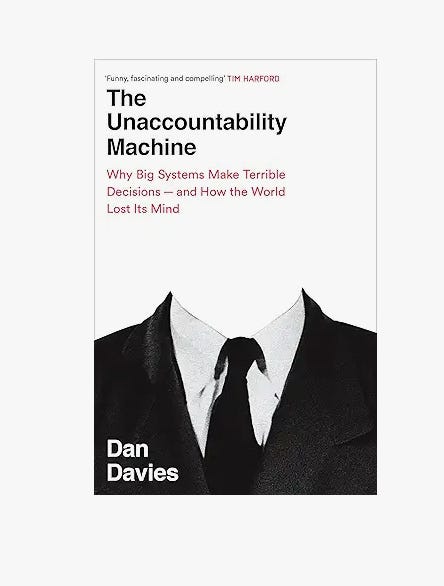
Whether it is our banks, insurance companies, utilities or tax offices, the notion that these institutions somehow care about us, their customers, became a joke a long time ago. How did it happen? Davies gives us his own theories. He describes ‘accountability sinks’ in terms of outcomes that cannot be blamed on anybody. It’s almost as if the organisation itself somehow creates processes that remove individual responsibility. Those processes evolve independently of any individual (or group) in some kind of strange quasi-organic way.
We might argue that someone must have originally been responsible for the structures and systems that developed their own ‘artificial intelligence’, the way of being that means nobody gets left holding the can. Or that someone should be responsible for not allowing the organisation to go rogue. In the case of the original designers, should they even exist, in most businesses they are long gone, usually enjoying the gains of their share options or reengineering another company to become accountability sinks. As to monitoring the current state of the business, nobody ever has an incentive to assign responsibilities back to individuals: it suits everybody to be unaccountable. The alternative involves far too much personal risk.
One question immediately needs to be asked: how do unaccountable organisations get away with it? In part, its a mystery. In part, they get away with it simply because they can. Treating customers with contempt has become a consequence-free activity for far too many businesses.
In a recent conversation with a serious player (CEO) in financial circles, I was regaled with examples of how investment companies, particularly those with ‘insurance’ in their name, have learned about consequence-free degraded customer service. Cost cuts in the various customer facing departments lead to mistakes and/or poor service. We might think that this will lead to the firms concerned losing business. But no, over time, they have somehow learned that if they all do it, their customers will have nowhere else to go. So the companies cut costs and service levels with gay abandon. With no consequences other than angry customers who are forced to stay put. I have my own real life multiple examples of how any interaction with savings/pensions providers is too often an end-to-end shit show.
All that happens to the leaders of these businesses is….nothing. Actually, that’s not quite true. They gain stellar reputations as bottom-line enhancing cost cutters. They cut their way to the top jobs and personal riches. If anyone wonders why so many firms are not investing, here is the explanation: the easiest route to the C-Suite is to be known as a successful cost cutter.
I don’t want to single out financial services, but it is the business I know best. Back in the 1980s, when people still drank at lunchtime, I once heard the senior partner (now long deceased) of a major stockbroking firm (also long dead) refer to customers as ‘the stuffees’. As in the idiots who got stuffed with over-valued stocks and shares of one kind or another. Or simply got over-charged for the privilege of buying reasonably valued securities. Yes, I have often wondered about my career choices. Of course, examples - contemporary ones - about treating customers with contempt are legion across many industries.
Swathes of the private sector live in a blame-free universe and, accordingly, make our lives miserable. But perhaps the biggest, most egregious, example of client contempt - a rather large accountability sink - is to be found in our modern politics. Brexit also exists in an accountability-free zone. While badly behaved companies have evolved systems for absolving any named individual, we know with precision who has degraded our daily lives via Brexit. Oddly, knowing this person’s name doesn’t seem to solve the accountability issue. Quite the reverse in fact.
Brexit
Nigel Farage is often described as the most consequential UK politician of the modern era. That’s because he single-handedly delivered Brexit. Like those Japanese soldiers found deep in jungles decades after the war ended, some people still carry on the Brexit fight. But every sane and rational analysis has concluded that it was a disaster. The debate is settled. The only reasonable discussion is over how big the disaster has been. We argue about numbers but they all have a minus sign in front of them. Any travelling Brit is incandescent about passport queues and the lack of work/study opportunities for their kids. Talk to any UK exporting business and see how difficult life has become. The latest blood sport of political journalists is detailing how Keir Starmer is going to have to choose between the USA and Europe, once Trump does his trade war thing.
But Farage is now the bookies favourite to be the next UK Prime Minister. He is ahead in the opinion polls. If that’s not an accountability sink I don’t know what is.
The Reform Party is targeting local elections next year and Welsh Senedd (parliament) elections in 2026. These are to be the bridgeheads that, once crossed, will lead to the General Election at the end of the decade and, hopes Farage, replacement of the Tories by Reform as the main party of opposition. Vaulting ambition, of course, doesn’t stop there.
Brexit is taboo in the UK, which is a big part of the explanation for why Farage is not being held accountable for it. You can’t pin the blame on anyone for something that you avoid talking about at all costs.
Additionally, some of the blame lies with the first six months of the new Labour government. Missteps with regard to things like pensioners winter fuel allowances, a hopeless budget, feathering the public sector’s nest while taxing business have all created an impression of dithering and a whiff of old-fashioned by 1970s style Labour policies. For all the talk about economic growth there wasn’t really any increased investment in Reeve’s first budget.
The always excellent Peter Foster of the FT puts it well
When an inertia narrative has taken hold, it becomes very difficult to escape. Witness Sir Keir Starmer’s ‘reset-that-wasn’t’ speech at Pinewood Studios, which had the perverse effect of drawing attention to the inertia narrative rather than scotching it.
Here’s Professor Simon Wren Lewis on public sector investment, just one of many disappointments:
Another potential piece of evidence of political short termism is the budget itself. If you want to recharge the economy by expanding public investment you need to substantially increase public investment relative to the past. Yet after the budget the average share of net public investment in GDP over the next five years is projected to be 2.6%. That compares to 2.4% in the five years up to and including 2023/4. This will do almost nothing to boost economic growth or private sector investment.
At least one failed Starmer ‘reset’ has added to the gloom and led to a widespread belief that they don’t really know what they are doing. Brussels insiders note that Labour keeps talking about improved relations with the EU but then does precisely nothing to achieve that aim. Reeve’s went to Brussels last week and said nothing new. In fact, she pissed a lot of Eurocrats off with hints that the Brits have learned nothing since 2016:
”New Brexit deal is in your best interests, Reeves tells EU” was the headline in The Times. That raises hackles in Brussels. As one EU official waspishly observed: “Are we going back to a UK defining the EU’s interest?”
Polling suggests that the UK public is far ahead of Labour’s neuralgia about Brexit. This from the European Council on Foreign Relations:
A majority of voters in Germany and Poland – and a plurality in France, Italy and Spain – think that the EU should be willing to make economic concessions to the UK to secure a closer security relationship. And in the UK, a majority of voters (including 54 per cent of those who voted for Brexit in 2016) would be willing to accept free movement in exchange for a stronger economic relationship with the EU. Our polling also shows that when it comes to their economic future, tackling migration, and even security, more Brits look to the EU than to the US as their country’s most important partner.
Farage’s bet is a simple one: Starmer will fail and Reform will be the only party not to have led the UK up a blind alley. Starmer’s missteps and resets are playing right into Farage’s hands.
Here’s a suggestion for Labour: hold Farage to account for Brexit. Failing to do so is blocking a proper recognition of the damage that has been done and, more importantly, the chances of doing anything about it. It’s called having political courage.
If only we were allowed to talk about Brexit. And, therefore, do something about it. Accountability isn’t what it used to be.
I really like your concept of the “Accountability sink” - sadly, I see it frequently in governmental bodies and large commercial (mainly global) organisations.
It’s a wonderful way to ignore wilfully inflicted damage.
The term “systemic” is another “blameless” handle.
We as a society need to grow our courage and outrage and be vocal about it.
If Farage gets to lead the UK - there will not even be a “whiff” of the Empire remaining!
THE BIGGER THE DISASTER, THE MORE IT IS SPREAD AND THE LESS ANYONE IS ACCOUNTABLE FOR IT.
I am waiting to see what happens if Trump actually gets to impose his tariff plan. That will, I am sure, cause huge and widespread pain.