
Explaining a Riot
Not all protests are riots. Not all riots are protests.

Inevitably and understandably, many people have weighed in with their theories about why the UK has had a riotous August. Some - many - of these explanations fall into the trap of over-simplification. ‘It’s just racism’ or ‘Islamaphobia’ or ‘anti-immigration’. That’s not wrong of course, but is only a part of the truth. The truth, if is discoverable, is important for its own sake but is also necessary in assessing the multiple policy prescriptions put forward by those who say they know why the riots took place.
When faced with complexity we try to explain. Astrologers put each of the 8 billion of us into one of 12 zodiac signs in order to explain and predict. That level of simplification is extreme but is often a big part of attempts to explain.
Myers-Briggs type personality tests end up with slightly more boxes to fit us in - 16 instead of the 12 favoured by astrologers. It’s a step up from astrology but only a small one. Nevertheless, too many people fall for it - companies still pay good money for pseudo-scientific analysis of their employees.
Economists build models with multiple simplifying assumptions about human behaviour and economic relationships. They do that for two reasons: the economy is so complex that even the most powerful of today’s computers couldn’t handle reality. Even if those computers existed, our ability to write down those relationships doesn’t exist: we do not yet have the mathematical and programming ability, nor do we have the data necessary to test whether what we think we know is correct.
The temptation to simplify arises from ignorance clashing with the desire to explain. Economists justify their simplifying assumptions via a cod-philosophy that allows them to conclude that nothing is lost, accuracy is still there in their models. Only economists are surprised by the observation that nobody listens to them any more.
Riots: Who, what, where and why?
The questions being asked of the riots focus on the motivations of the rioters, whether or not their grievances are legitimate, and what, therefore, should be done about them.
Tangential questions have arisen about the role played by semi-detached agitators such as Tommy Robinson, Nigel Farage, Elon Musk and some of the candidates for leadership of the Conservative Party. These people are described as ‘exploiting’ the situation on Britain’s streets. I think a better way to view the actions of Farage and his acolytes is to say they are predators. That is to say their actions run deeper and are much more consequential than mere exploitation.
No trustworthy estimates of the numbers of rioters can be found. I’ve seen one commentator suggest that the total would easily fit into a second-tier football stadium (football makes several appearances in this story). Many have suggested that the same rioters popped up in multiple locations, prompted and organised by social media. Apart from the truly weird scenes in Belfast, where I recall the phrase ‘recreational rioting’ being used a lot during The Troubles, the August riots were an exclusively English phenomenon.
The explanations put forward for the riots range from the superficial to those that try to address the complexity. The best example of this is to be found in a recent edition of the Financial Times that contained two articles that couldn’t have stood in greater contrast to each other. One, written by the normally excellent Camilla Cavendish, read like a columnist that was up against a deadline, couldn’t think of much to say, wished they were on the beach and just needed to fill a page. First, the headline:
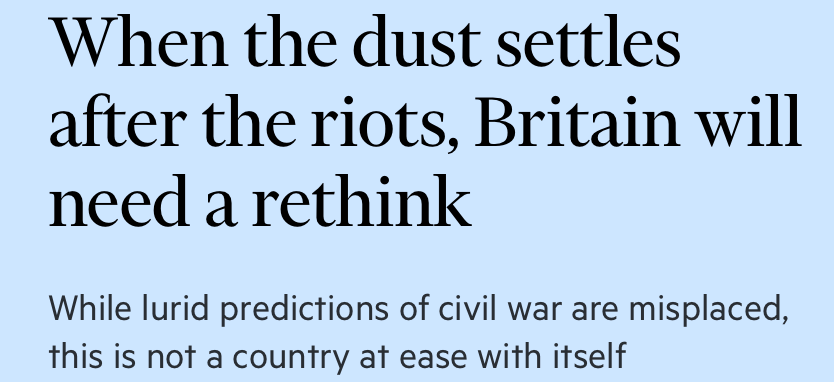
While Cavendish isn’t responsible for the sub-editor’s summary of her column, the headline is about the best that the sub could have done, given the paucity of insight - the sheer lack of serious thought - contained in the piece. Nods are given to Britain’s history of riots; ‘two-tier policing’; Ireland gets a mention with the Dublin riots of last year. Context is appealed to regarding the multiple clips that go viral on social media. That policeman was indeed attacked prior to kicking a prone man in the head, but we get no mention of the fact that kicking any human being in the head while he is flat on the ground doesn’t require much context. Cavendish’s conclusion: we need to address poverty and the evident lack of social cohesion. Who knew?
Simon Kuper, always excellent, provides an interesting contrast. He starts with the tough question: ‘What makes somebody riot?’ Kuper supplies multiple answers to a deceptively simple query. Yes, they were, in part, an emotional but utterly wrong response to the appalling murders of three little girls in Southport.
There are, according to Kuper, centuries-old patterns to riots. History is very important here. Riots have almost always been fuelled by misinformation, long before social media came on the scene. Race riots have been seen many times before in the UK and elsewhere. My home town, Cardiff, witnessed one of the first ones in 1919. Some historians point to the anti-Irish riots over half a century earlier as being the first recorded Uk race riots. Again in Cardiff.
The Versailles meetings of The Estates General in 1789 - just before the French revolution - were minuted by an attendee from Provence. His Paris-based printer distributed his scribblings and caused quite a stir. The Tweets of the day, as it were. And so on throughout history.
The Southport killer was not a Muslim asylum-seeker. While Farage’s and Robinson’s comments have received much deserved negative publicity, Kuper points out that many riots are leaderless. While politicians and other malign actors may incite and/or exploit - I suggest they are better viewed as predators - they are merely driving forces rather than riot leaders. That’s a crucial distinction. And the biggest drivers of today’s rioters are social media platforms. Their sheer scale and reach mean that something new is happening. But even that isn’t the whole story.
Riots are typically Summer phenomena. Degrees centigrade play a role. Even more important are the bonds that bind rioters into group identity. The need for tribal affiliation runs deep - the need for group hugs, real and metaphorical. Rioting elicits human connections. “Personal identity merges into group identity…transgressing social norms with other people creates a particular bond…riots make rioters feel less lonely”. The Washington DC January 6 rioters spoke afterwards of the deep camaraderie they felt.
That point about social isolation is important. Particularly male isolation. We insist on housing too many people in low-quality houses and flats with no social infrastructure. Nimby’s are not wrong when they object to soulless housing development proposals that contain no community facilities - pubs, shops, sports centres, medical centres, cafes, libraries and all the other things that might encourage people away from dingy flats into social interaction.
Kuper reminds us that social scientists posit two competing theories of the riot. One sees a bunch of thugs who merely deserve punishment. The other describes a bunch of rational actors with real grievances, ones that must be addressed. The two theories have been rehearsed in countless commentaries about the recent riots.
I’m tempted to say that the two theories are as reductionist as astrology but there is something more to these ideas than that. Most importantly, they are not mutually exclusive. But they are not enough of an explanation, something that Kuper acknowledges when he cites criminologists who say some people riot simply because it is fun. From The Guardian:
people just like rioting … some have really nasty motives and some are just vulnerable and get caught up in it
I once knew otherwise model citizens who enjoyed a good punch-up every Saturday at Chelsea football matches. I’m not the only one to note the physical and behavioural similarities between todays rioters and 1970s football hooligans. As Kuper says, those rioters on the terraces of football grounds did it simply because they found it exhilarating. Don’t reject explanations just because they make no sense to you.
More generally, away from football stadiums, there is the sheer thrill of anarchy - rebellion for its own sake doesn’t need a rationale. Just ask James Dean. And when it all kicks off, don’t underestimate the joy of joining in. The copycat rioter. Just one story as reported in the Guardian:
Last Sunday afternoon a homeless mother-of-five left her hotel room in Middlesbrough to nip to a nearby shop. On her way, 34-year-old Stacey Vint bumped into some locals she knew and joined them on their way to what had been described on social media as a “pro-British” protest in the town centre…One of the group she was with asked her to give him a hand with a wheelie bin, which had been set on fire, and she did, Andrew Turton [defence barrister] said. “Stupidly, she took hold of the bin, pushed it towards police, and fell at their feet.”
Five days later, she found herself being handed a 20-month prison sentence
Doing something about the true causes of all this requires deep thinking. It will involve much more than the security response - necessary though that is. The predators must also be tackled. Social media is now a societal cancer. We need to recognise the similarities between those that have disappeared down conspiracy theory rabbit holes and the rioters (they are sometime the same people of course). That need for human connection and the group hug is very powerful.
History teaches that riots are recurring events - there are limits to what we can do. But we can and should do something. We need to reexamine the ancient and modern philosophers who explore the nuances of what ‘free speech’ means. It definitely isn’t what Elon Musk says what it is: that particular predator has his own desired vision of global anarchy. Farage seems to just enjoy the fun of it all, albeit from a safe distance.
There are similarities and differences between each riot. Find a way to shut down the platform owners and the ‘influencers’. We need laws that mean future predators face the courts as often as the rioters. Rein in, finally, social media.
Social isolation has been shown in umpteen studies to be a cause of mental ill-health, premature death and riots. Stop building towns and cities with social isolation as key design feature.
To the extent there was a unifying theme behind the riots, no matter how flimsy - or just wrong - it was immigration. Or, rather, anti-immigration. Please do not nod along sympathetically to those who say that immigration is a big problem.
Facts
We know facts don’t change minds. That’s a statement about the average mind, as well as the mind of the typical conspiracy theorist and/or rioter. But it doesn’t mean that some minds can’t be changed or, more importantly perhaps, some people can be persuaded to resist the lies of the predators. Keep hammering away at the facts. Here are some facts about immigration from the always excellent Peter Foster of the FT:
Immigrants are net contributors to taxes, net contributors to the NHS. Immigrants don’t use the NHS as much as the indigenous population because they are younger (and therefore healthier). 20% of doctors and 33% of nurses are foreign
Immigrants don’t reduce the amount of jobs, don’t lower overall wage levels.
The record year (2022) for ‘small boat’ arrivals saw 3.5% of total immigrants arriving in this way.
In 2023, 8% of immigrants were asylum seekers (most arrive at airports, not on small boats). All the other immigrants were using the legal, post-Brexit, visa and points-based immigration system.
Government spending on processing asylum seekers represents 0.3% of total state spending.
Crime is at a four-decade low in the UK. There is no link between immigration and crime - immigrants are just as likely to be criminals as the indigenous population. Which means not very likely. There really is no need to ‘reclaim the streets’.
Immigration is good for economic growth and helps the country’s debt dynamics.
Foster nails it here:
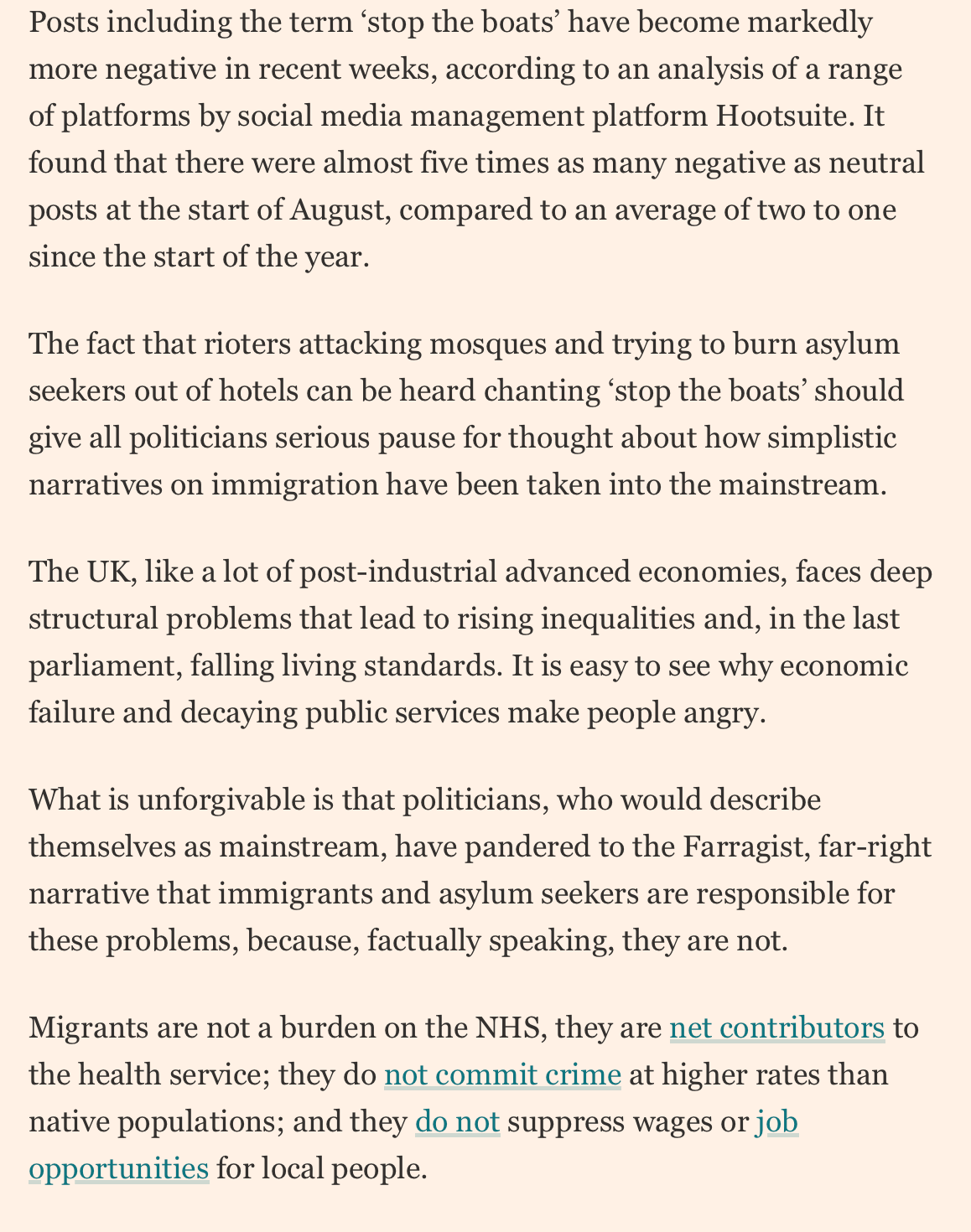
The message is, for once, simple: Britain has loads of problems. They are not caused by immigration.